Faucet & Sink Repair
Cure dripping taps, weak streams, seized shutoff valves and leaking hose bibs.
A disposal that hums and will not turn, leaks into the cabinet or sends dishwasher water back up. Most jams clear with a hex key, and most leaks come from a seal or a connection. If the unit drips into the cabinet or pushes gray water into the dishwasher, switch it off at the wall and ring the dispatcher.
Switch the disposal off at the wall, never put a hand inside, and call if it leaks.
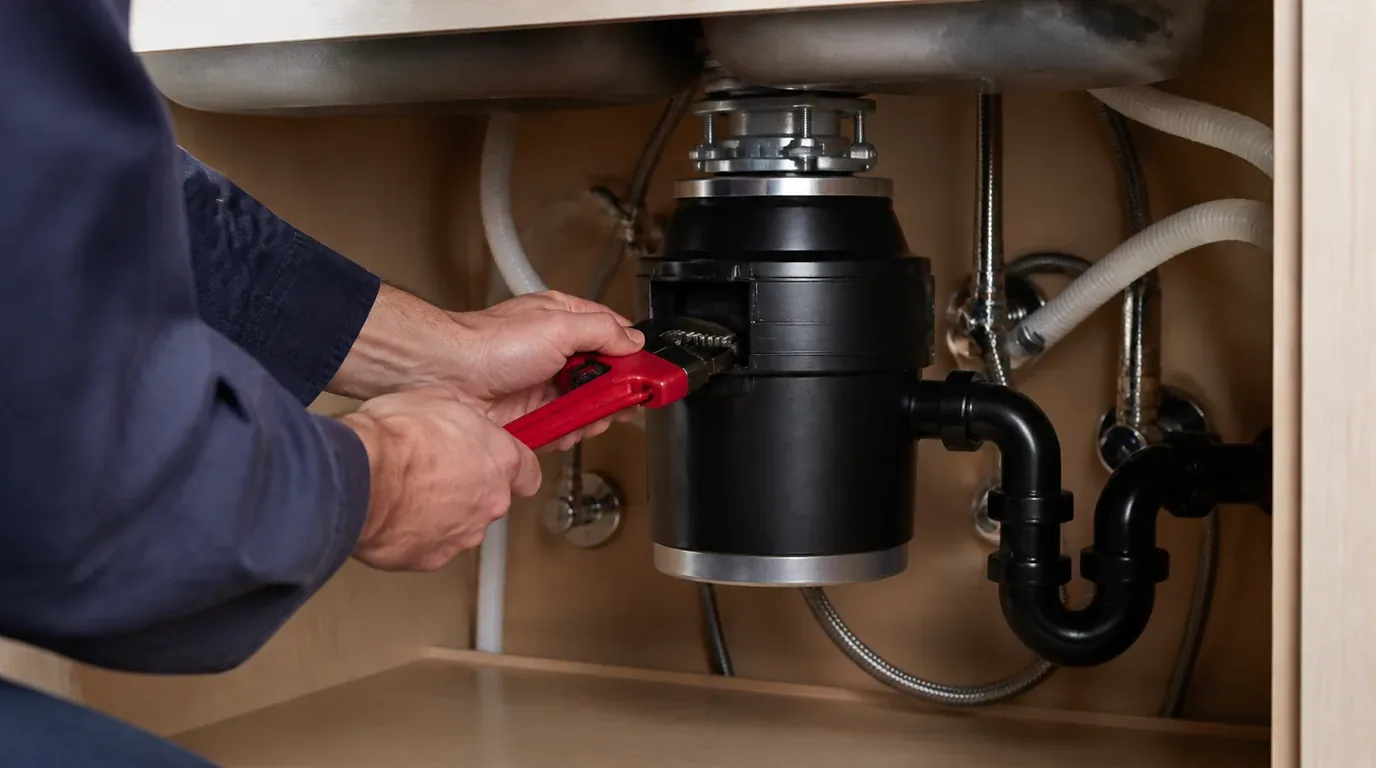
Turn the disposal off at the switch and unplug it or flip the breaker. Insert a hex key into the socket under the unit and work it back and forth to free the flywheel. Press the red reset button on the bottom.
Use tongs to remove anything stuck in the chamber. Never reach in by hand, even when the unit is off.
Leaks show up at three places. The flange at the sink seals with putty or a gasket, the discharge pipe connects with a rubber gasket and the dishwasher inlet has a hose clamp. A leak from the body itself means the housing has failed and the unit needs replacing.
Dry the cabinet and run water to see where the drip begins. A flashlight and a paper towel help.
Freeing a jam is quick and a swap takes little longer. These points change the total.
Ask what warranty comes with the unit and with the labor.
A disposal that backs up often connects to a drain line that is partly clogged farther down. If water backs into the second sink or the dishwasher, the kitchen branch line needs cleaning.
Mineral scale from moderately hard water can build inside the grinding chamber and on the drain. A periodic flush with warm water helps.
A replacement uses the same mounting ring on most sinks. The plumber disconnects the old unit, mounts the new one, connects the drain and the dishwasher line and wires or plugs it in.
Electrical work on a hard-wired unit should be done by a qualified person. Ask about a cord kit if the sink has an outlet under it.
Run cold water while the unit runs, and for a short time afterward, to flush the line. Avoid grease, coffee grounds in bulk, fibrous vegetables and large bones.
The city asks residents to keep fats, oils and grease out of the sewer. A disposal does not change that, and grease that goes through it still hardens down the line.
Small changes make it last longer.
Cure dripping taps, weak streams, seized shutoff valves and leaking hose bibs.
Open clogged kitchen, bath, laundry and main drains, then find out why the stoppage came back.
Blast grease, scale and roots off the pipe wall when a cable only punches a hole through the clog.
The flywheel is jammed. Turn off power, use a hex key under the unit to free it and press the reset button.
A leak at the flange, gasket or hose can usually be repaired. A cracked housing needs a new unit.
The kitchen branch line is partly blocked. Disposals add food waste that can build up and clog.
No. Chemical cleaners can damage the seals and are unsafe to handle.
Cut power to it, clear the cabinet and call. Drips from the mounting flange, the gaskets or the drain hookup can usually be repaired, while a split casing means a new unit.
Turn it off at the switch and call. Say what it is doing and where it leaks.
Service area centered on Westminster and the nearby Denver north-metro cities.